

Lead distribution · ping tree · operator-built
A Lead Distribution Platform
for Top 1% Operators.
Route leads at scale, manage real-time buyer competition, and see exactly what you're making after publisher costs and ad spend. Built for operators who want more control, better margins, and fewer black boxes.
I've spent years building and operating lead distribution systems. TierX is the one I always wished existed.
Rob Fitzpatrick, founder
We reply within 1–2 business days · flat monthly, no cut of your sales · or run it on your own servers.
Who built this
I didn't need another lead router. I wanted a better way to run the business.
I've been generating and selling leads since 2009, and over the years I kept running into the same problem: the software could move leads, but getting the answers I actually cared about was harder than it should have been.
I wanted to compare today against yesterday, hour by hour. I wanted to know what changed, where margin moved, and which publishers, campaigns, buyers, or routes were responsible.
I wanted my data to actually feel like my data—easy to access, analyze, export, and build around.
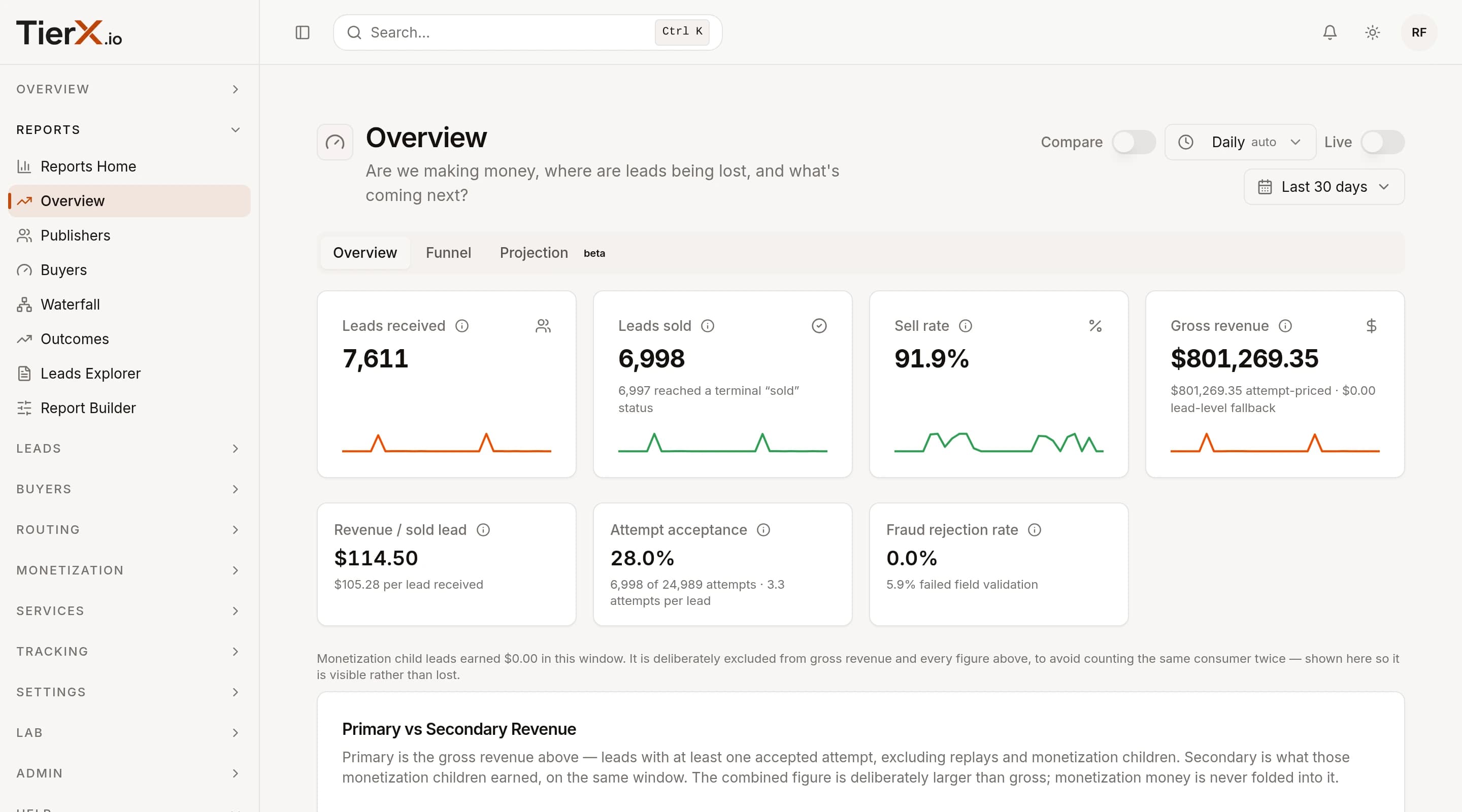
I wanted ad costs tied directly into the numbers, with Google Ads and Meta connected so I could see what a campaign actually made, not just what it sold.
And when something changed, I didn't want to dig through five screens to fix it. I wanted to open a ping tree, see buyer positions immediately, move things around, disable a buyer, or turn one back on—in seconds.
That's why I built TierX.
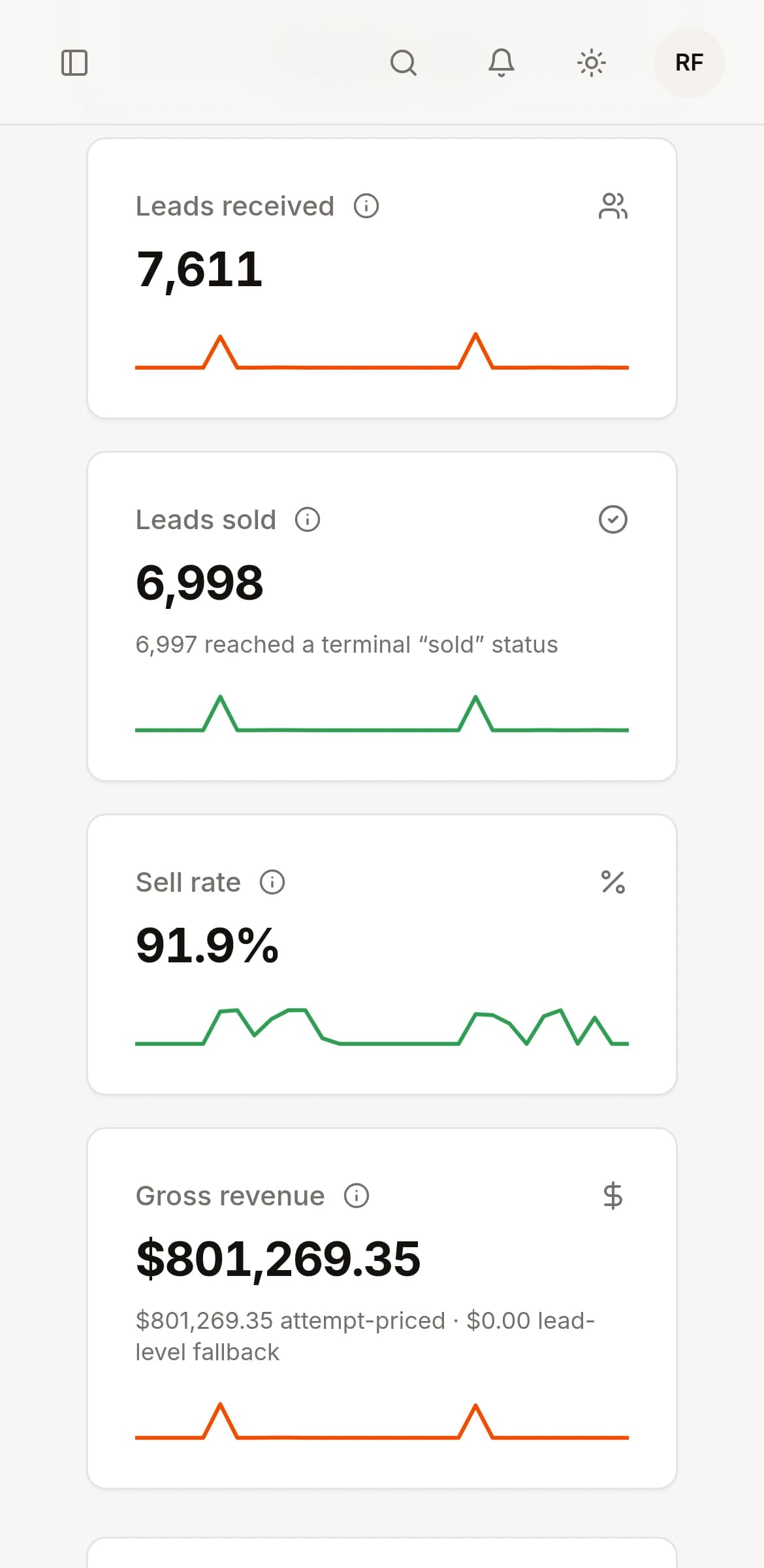
- Reporting that helps you make decisions.
- Your data without the handcuffs.
- Acquisition costs tied to actual revenue.
- And a ping tree you can operate at the speed the business moves.
Rob Fitzpatrick · founder, TierX
What a hosted platform can cost
Per month, at mid volume. TierX is a flat subscription that does not climb with your lead count, and takes no percentage of what you sell.
Profit down to the campaign
Google and Meta spend beside the revenue it produced, with break-even CPC per campaign and a verdict on which sources are losing money.
Life for an unsold lead
Retry it on another tree, recapture it by SMS or email, or hand it to your CRM, and see what the recovery earned.
Yours to keep
License it and your buyer list, your payouts and your lead data stay on your own infrastructure.
This is the ping tree,
running.
One lead, a tier of buyers, four ways to sell it. Switch the mode at the top of the instrument and watch the walk change.
- 01Pick a mode, watch one lead sellWaterfall, counter-bid, ping-post auction or shared lead. Each is a different negotiation, not a preset.
- 02A refusal becomes a numberWhen a buyer will not pay the ask, it can counter. The best bid across every tier wins.
- 03Every ping lands on the tapeWho was asked, what came back, what it sold for. That is the same record your reports read from.
Why an operator switches
Three questions your current dashboard can't answer.
Every platform in this category routes leads and maps fields. If you cannot answer these three by 9am, you are running on revenue, not profit.
- 01
Which campaign actually made money last week?
Not clicks. Not leads sold. Contribution profit per campaign, after the publisher payout and the Google or Meta spend that produced it.
Connect your ad accounts through agencyplaybook and TierX puts the spend next to the revenue it produced. Every campaign shows break-even CPC against what you are paying right now, plus a trailing 7- and 30-day verdict naming the traffic sources that are losing money. Where a figure cannot be computed, TierX shows a dash and says why. It never invents a profit.
- Contribution profitrevenue − publisher payout − ad spend, per campaign
- Break-even CPCthe most a click can cost and still pay for itself
- Verdictbleeding sources found · nothing bleeding · could not be evaluated
Or just ask it: "which publisher lost money last week?" and get the number, with the definition it used.
- 02
What happened to the lead every buyer just rejected?
On most platforms it is a row marked unsold. Here it can be retried on a second tree, recaptured by SMS or email, or handed to your CRM, automatically.
Build the flow from a recipe in a minute and publish it. From then on every unsold lead gets its second try without anyone remembering to send it, and the Flow economics card shows what each recovery actually earned. A flow never changes whether a lead sold or what it sold for. It only acts on the outcome.
- Recipesretry on another tree · SMS or email recapture · deliver to HubSpot or Pipedrive
- Reportedrevenue attributed to each flow, per window
- 03
Is a buyer about to go quiet on you?
A 48-hour projection warns you before a buyer exhausts its cap, so you find out from the report, not from a revenue dip two days later.
Buyer scorecards plot every buyer on accept rate against latency, sized by what it paid. Realized value tracks what actually banked after adjustments, not what was accepted. Triage separates a buyer that is near cap from one that is misbehaving, because those need different phone calls.
- Warnscap exhaustion 48 hours out · pacing · near-cap vs misconduct
- Scored onrealized revenue, not acceptance rate
Two places your money leaks. Both close here.
Most operators lose margin twice on the same lead: once to the buyer who said no, and again to the platform taking a slice on the way past. Here is what each one costs on a hundred leads.
Leak 1 — the buyer said no
Illustrative figures, chosen to show the arithmetic. Your acceptance and bid rates will differ; the point is that the 38 are worth something instead of nothing.
Leak 2 — the platform's slice
TierX charges a flat subscription. Route twice the volume next month and the bill does not move until you cross your plan's included leads.
Traffic Guard
Screened before anyone can buy it.
Your rules, your thresholds, every decision logged.
- IP
- Phone
- Domain
- Velocity
- Device
Illustrative · one example cohort of 1,000 leads, rates synthetic. Every dot is a lead; the bands and their score ranges are the real ones.
Your buyers, your payouts, your sources. Kept where you decide.
On any hosted platform, your buyer relationships and what each one pays you live inside someone else's system. For many operators that is a fine trade. If it is not one you want to make, TierX gives you two ways out of it.
Option A · license it
Your server. Your book. Your login.
TierX runs on PostgreSQL and the application, nothing else. Put it on your own infrastructure and there is no vendor account in the loop: your buyer list, payouts and lead data stay on hardware you control.
- Dependencies PostgreSQL + the app
- Where the book lives with you
Option B · hosted by TierX
Encrypted at the lead, masked on the screen.
On the hosted plan every lead payload is encrypted at rest under a key bound to that lead. Ordinary dashboard use shows a masked version. Reading the real thing takes a passphrase, an MFA code and a written reason, and it is written to an append-only audit table you can pull any time.
- At rest AES-256-GCM, bound to the lead
- In the clear passphrase + MFA + written reason
Every dollar is traceable to the ping that earned it.
When a buyer disputes a lead, or a source starts underperforming, the argument gets settled by the record instead of by whoever shouts louder. Here is what gets written for a single lead.
Accepted on a publisher key, in whatever shape they send
JSON, form-encoded or XML, detected from the content type. Duplicate submissions are claimed atomically inside a five-second window, so a double-fired form does not become two leads. If that check itself fails, it fails open rather than dropping your traffic.
Their field names become yours
Inbound fields map to a canonical dictionary per niche, then get sanitised: phone, SSN and email normalised, IP and user agent enriched, all before anything is validated. Required-field and format rules are configured per niche and cached, not hard-coded.
Scored for fraud before a buyer is contacted
Short-circuit rules reject outright. Everything else accumulates weighted signals across IP, email, phone, domain and velocity into one score, which resolves to allow, flag, degrade or reject. It is deterministic: the same lead scores the same way twice, and you can read the trace.
The tier walk, recorded attempt by attempt
Every ping is one row: which buyer, what was asked, what came back, how long it took, and the exact request and response payloads. When bandit policies are enabled they choose against realised revenue rather than acceptance rate, and if a guardrail trips the deterministic waterfall takes over. Optimisation never blocks a lead.
Sold, then sealed
The winning price books to the ledger the reports read from. Then the payload is encrypted at rest and the plaintext is cleared. What stays visible is a masked version. Reading the real thing takes a passphrase, an MFA code and a written reason, it lasts five minutes, and it is written to an append-only audit table.
Four ways to sell the same lead.
Switch the instrument at the top between them. They are not presets on one algorithm: each is a different negotiation, and you can mix them per niche. More ways to sell a lead means fewer leads that go unsold.
Sequential waterfall
Buyers sit in tiers, ordered by what they pay. The lead goes down the stack and the first acceptance ends the walk. Simple, predictable, and the fallback everything else degrades to.
Price reject + bid
A buyer that will not pay your asking price may name its own. Bids are collected as the walk continues and the best one across every tier wins, so the lead you would have lost sells lower instead of not at all.
Ping-post auction
Every buyer is pinged at once rather than in turn. Bids arrive concurrently, the highest takes the post, and the walk costs one round trip instead of five.
Shared lead
Some verticals pay for the same lead more than once. The lead is placed with several buyers at declining positions, and each placement is recorded with the position it held.
A flat subscription. Never a percentage of your sales.
Hosted platforms at mid volume can run $15,000 to $20,000 a month or more, and most will not quote you until you have sat through a demo. TierX will be a flat monthly subscription with no per-lead cut and no setup fee. The price is not set yet, and early-access operators help set it: request access, tell us your volume, and we will work it out with you directly, and help you move your buyer mappings across.
Starter
Pricing announced at launch
- 500K leads and 500K pings a month
- All four distribution modes
- Traffic Guard fraud scoring
- Unlimited users and buyers
- $0.0011 per lead beyond that
Growth
Pricing announced at launch
- Everything in Starter
- Higher-throughput routing
- AI buyer onboarding
- Realised-value optimisation
- Monetisation flows and retries
Scale
Pricing announced at launch
- Everything in Growth
- Highest routing throughput
- Publisher and buyer portals
- Priority support
- Hands-on migration from your current platform
Or license it and run it yourself
Deploy TierX on your own infrastructure. PostgreSQL and the application, nothing else: no Redis, no broker, no managed queue. Your buyer list and your lead data never touch someone else's servers, and nobody at TierX can read them.
Early-access pricing. Flat monthly billing, no setup fee, and no percentage of what you sell.
The questions that actually come up.
Straight answers, including the ones that are not flattering.
What does it cost?
A flat monthly subscription tiered by throughput, or a license if you would rather host it yourself. No setup fee, and no percentage of your sales. Early-access pricing is announced at launch — the tier structure is above.
How hard is it to move off my current platform?
The part that usually hurts is re-mapping every buyer's fields. Paste a buyer's spec sheet and TierX extracts it, maps it against 479 canonical fields, repairs what does not line up, and hands you the integration to approve before it saves. Migration help is included on Scale.
What do I have to run to host it?
PostgreSQL and the application. The queue, the retry logic, the outbox and every background worker are Postgres rows claimed with FOR UPDATE SKIP LOCKED, so there is no Redis, no broker and no managed queue in the dependency list. It also runs on AWS Fargate if you would rather not hold the box yourself.
Are the numbers on this page real?
The prices are real. The buyers, leads and bids in the live instrument are synthetic demonstration data, labelled as such, chosen to show how each distribution mode resolves. The worked examples in the economics section are illustrative arithmetic, not measured results. There are no customer names or testimonials here because there are none to quote yet, and we would rather say so than borrow someone else's.
What happens to a lead nobody buys?
It is recorded as unsold with the full attempt history, and, where configured, handed to a fallback group, a retry tree or a monetisation flow that can try to earn something from it downstream. Then it is encrypted like any other lead.
Run your leads through a tree built by someone who had to live with the numbers.
Tell us your niches, your volume and what you pay today. We reply within 1–2 business days with a straight answer on fit and cost, and a walkthrough on your own numbers.
Flat monthly billing · no setup fee · no cut of your sales · or license it and self-host.